Contemporary furniture for flowing, spacious interiors combines considered proportions, clear circulation paths, and adaptable pieces rather than simply minimal styling. Brands including B&B Italia, Knoll, Herman Miller, Muuto, and IKEA offer different ways to achieve that balance—from modular seating and sculptural tables to compact storage and flexible dining furniture. The right choice depends on room dimensions, how people move through the space, and whether a piece can serve more than one purpose. That matters in a world where homes must often support work, rest, and entertaining: the U.S. Environmental Protection Agency estimates that people spend about 90% of their time indoors, making comfort and usability consequential parts of everyday life.
How contemporary furniture supports flowing, spacious interiors
“Contemporary furniture” describes furniture shaped by current design practice, materials, technologies, and lifestyles; it is not a fixed historical style. For a flowing interior, the useful attribute is spatial performance: how a piece affects movement, sightlines, flexibility, and perceived room size. The American Institute of Architects’ residential design guidance emphasizes circulation and functional relationships between rooms, while interior-design practice commonly treats clear pathways and appropriately scaled furnishings as foundational planning decisions.
The most relevant characteristics are proportion, visual openness, and adaptability. Low-profile seating can preserve views across a room; raised legs expose more floor; rounded edges can soften routes around furniture; and modular components can be reconfigured as needs change. These are not guarantees that a room will feel larger—the result also depends on daylight, color, storage, and layout—but they offer practical ways to reduce visual and physical obstruction.
Modular furniture: flexible layouts for changing rooms
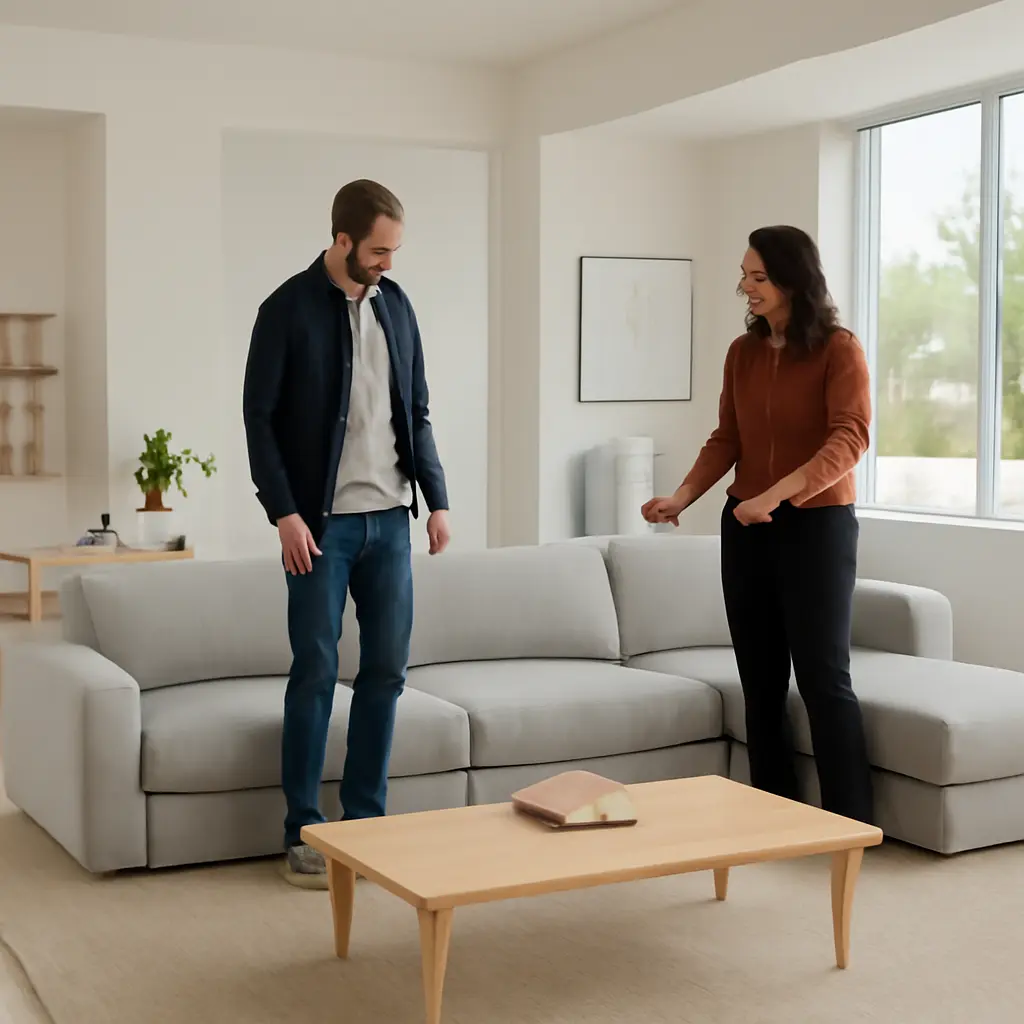
Modular furniture consists of separate components designed to work together in more than one configuration. Modular sofas, shelving systems, and extendable dining tables can adapt to gatherings, daily use, or a changed floor plan. B&B Italia’s Camaleonda sofa, originally designed by Mario Bellini in 1970 and later reintroduced, is a notable example of a sectional system whose elements can be rearranged. Its generous modules suit larger rooms best; in a compact room, measuring the footprint and preserving a clear route around the sofa is essential.
Open, elevated forms: preserving sightlines and floor area
Open-form furniture uses slender frames, exposed legs, or visually light materials to make more of the floor and surrounding space visible. Knoll’s Saarinen collection and the wire-based designs associated with Harry Bertoia demonstrate how a table or chair can provide a strong visual identity without a bulky silhouette. This does not mean every lightweight-looking piece is comfortable or durable; shoppers should check seat dimensions, materials, stability, and care requirements as well as appearance.
Open forms are particularly effective when they support a coherent circulation plan. The National Kitchen & Bath Association’s kitchen-planning guidance, for example, uses recommended work-aisle dimensions to help people move safely between tasks. Although those measurements apply to kitchens rather than every living room, the broader lesson carries across: furniture choices should preserve usable routes, not merely fit within a room’s outline.
Which contemporary furniture brands suit spacious interiors?
There is no single best brand for every flowing interior. A useful comparison considers each company’s design strengths, scale range, configuration options, materials, and price level. The following brands illustrate distinct approaches; product availability and specifications vary by collection and market, so verify current details before purchasing.
B&B Italia: sculptural modular seating
B&B Italia is an Italian furniture company known for contemporary upholstered seating and collaborations with internationally recognized designers. Its modular sofas can anchor an open-plan living area while allowing separate seating zones to be defined without constructing visual barriers. The Camaleonda is the clearest example: its modular design supports multiple arrangements, but its substantial cushions and deep proportions make careful room planning important. It is a strong option for a spacious interior where the sofa can act as a centerpiece rather than obstruct a main passage.
Knoll: architectural clarity and enduring design
Knoll’s contemporary collections include furniture developed by designers such as Florence Knoll, Eero Saarinen, and Harry Bertoia. The brand’s work often pairs clear geometry with carefully considered construction, making it useful for interiors that need a focal point without a heavily ornamented look. Saarinen’s pedestal tables, for instance, replace the visual clutter of multiple table legs with a central support. Buyers should compare table diameter and chair clearance with the room’s actual dimensions; a clean silhouette cannot compensate for a crowded layout.
Herman Miller: ergonomic furniture and adaptable work zones
Herman Miller is especially relevant when a spacious home needs a work area that feels integrated rather than improvised. Its portfolio spans office seating, desks, and residential furniture, with an emphasis on ergonomics and product engineering. A well-chosen task chair and desk can create a functional work zone while leaving the rest of an open room available for other uses. The brand’s long-standing office-furniture expertise is useful context, but buyers should assess the particular model’s adjustability, dimensions, warranty, and suitability for residential use.
Muuto: contemporary Nordic forms and softer visual weight
Muuto is a Scandinavian contemporary design brand whose furniture and lighting often combine restrained forms with color, texture, and approachable proportions. Its chairs, side tables, and shelving can help make an open room feel composed without relying on oversized pieces. Such furniture is especially useful when a room needs a lighter secondary layer around a larger sofa or dining table. Check finishes and upholstery specifications carefully, since the best choice depends on household use, cleaning needs, and exposure to sunlight.
IKEA: accessible solutions for flexible living
IKEA offers a broad range of contemporary furniture at accessible price points, including modular storage, extendable tables, compact seating, and products designed for smaller homes. Its advantages are availability, variety, and the ability to combine storage with everyday furniture. In a spacious interior, modular shelving can define a zone while remaining more open than a solid wall. As with any retailer, compare assembly requirements, product dimensions, materials, and replacement-part availability rather than assuming that a lower price automatically means lower or higher long-term value.
How to choose furniture that keeps a room flowing
Brand reputation is only one part of a successful purchase. Before choosing a piece, map the room’s primary routes, note doors and windows, and measure both the furniture and the space needed to use it. The U.S. Census Bureau’s American Housing Survey tracks housing characteristics and household conditions, reinforcing that homes vary widely in size and configuration; furniture planning therefore works best when based on the actual room rather than a showroom display.
- Measure the full footprint, including doors, drawers, recliners, and extensions when open.
- Keep major routes between entrances and frequently used areas clear.
- Use a consistent visual language across large pieces, while adding contrast through smaller accessories.
- Consider dual-purpose pieces, such as nesting tables, storage benches, or extendable dining tables.
- Check upholstery performance, finish care, repair options, and delivery access before ordering.
Use scale and negative space deliberately
Negative space is the unoccupied area around and between objects. It gives the eye room to rest and leaves practical routes through a space. Instead of filling every wall or corner, group furniture around a purpose: conversation, dining, reading, or work. A large room may benefit from a generously sized sofa, but it can still feel crowded if the sofa blocks a window or splits a natural route. A smaller arrangement with a clear perimeter path may function better.
Balance open-plan zones with flexible pieces
In an open-plan interior, rugs, lighting, and furniture groupings can suggest separate zones without interrupting sightlines. A dining table can mark the transition between kitchen and living room, while a low bookcase can provide storage and partial separation. Mobile or modular pieces make those zones easier to adjust. For example, a homeowner who occasionally hosts larger groups might use a standard dining arrangement every day and add an extendable table or movable chairs when needed.
Consider indoor comfort and product longevity
Furniture affects more than appearance: it influences comfort, maintenance, and how readily a room can be adapted. The EPA’s estimate that people spend roughly 90% of their time indoors underscores why everyday indoor environments deserve attention. For furniture decisions, that means considering ergonomic support, cleanable surfaces, responsible material disclosures, and expected product life. Certifications and environmental claims should be checked against their specific standards; a “sustainable” label alone does not explain a product’s full impact.
Conclusion: choose furniture around movement, not just style
The best contemporary furniture brands for flowing, spacious interiors are those whose pieces support the way a household actually moves and lives. B&B Italia offers expressive modular seating; Knoll brings architectural clarity; Herman Miller supports ergonomic work zones; Muuto contributes refined, visually approachable forms; and IKEA provides flexible options across a broad range of budgets. Their shared value is not a single look, but the opportunity to coordinate scale, function, and openness.
Before buying, measure the room, plan circulation, and compare materials and care requirements alongside appearance. Explore each brand’s current specifications and, where possible, test furniture in person. A spacious interior feels most successful when its furniture makes movement easy and gives every piece a clear purpose.
Sources: U.S. Environmental Protection Agency, “Indoor Air Quality,” https://www.epa.gov/report-environment/indoor-air-quality; American Institute of Architects, “AIA Best Practices,” https://www.aia.org/resources/6077668-aia-best-practices; National Kitchen & Bath Association, “Kitchen Planning Guidelines,” https://nkba.org/; B&B Italia, “Camaleonda,” https://www.bebitalia.com/en-us/camaleonda.html; Knoll, “Saarinen Tables,” https://www.knoll.com/; Herman Miller, “Home,” https://www.hermanmiller.com/; Muuto, “Furniture,” https://muuto.com/; IKEA, “Furniture,” https://www.ikea.com/; U.S. Census Bureau, “American Housing Survey,” https://www.census.gov/programs-surveys/ahs.html.