
Furniture and Mood: How Room Design Shapes Behavior, Comfort, and Daily Habits
Furniture is the movable equipment people use to support everyday activities, from sitting and sleeping to working, eating, and storing belongings. Its arrangement, comfort, and accessibility can influence how a room feels and how people use it: a supportive chair may make focused work easier, a clear path may encourage movement, and a welcoming seating area may invite conversation. These effects are not automatic—light, noise, personal preferences, and household routines matter too—but environmental psychology research shows that physical settings can shape people’s experience and behavior. The stakes are practical: the U.S. Environmental Protection Agency estimates that Americans spend about 90% of their time indoors, making the everyday design of indoor spaces worth attention.
Furniture design influences mood and behavior through comfort, layout, and perceived control
Furniture’s influence on mood and behavior refers to the ways its physical properties and placement support, discourage, or cue activities and emotional responses. Environmental psychologist Kurt Lewin’s influential formulation, often summarized as behavior being a function of the person and the environment, offers a useful framework: furniture is one part of the environment, interacting with individual needs and circumstances rather than determining behavior by itself. In practice, the relevant attributes include ergonomic fit, softness or firmness, visual appearance, accessibility, and the routes furniture leaves open.
The same object can have different effects for different people. A high counter may suit one person’s work routine but be uncomfortable for someone with limited mobility; a large sofa may feel relaxing to one household and obstructive to another. The following categories—ergonomics, spatial arrangement, and sensory character—show how these design attributes connect to daily habits.
Ergonomic fit supports comfort and sustained activity
Ergonomics is the design of equipment and environments to fit people’s capabilities and tasks. For furniture, that means considering dimensions, posture, adjustability, and how long someone will use a seat, desk, bed, or work surface. A chair that supports a user’s posture and allows a comfortable working position may reduce physical discomfort that competes with attention; a poor fit can make sitting, studying, or computer work harder to sustain.
The U.S. Occupational Safety and Health Administration’s computer-workstation guidance recommends arranging workstations to support neutral body positions, including relaxed shoulders and supported feet. This is a practical design principle, not proof that any particular chair guarantees productivity or prevents injury. Individual body dimensions, task demands, and opportunities to change position all matter. A useful habit is to adjust furniture to the person and task, then alternate positions and take movement breaks rather than expecting one setup to work all day.
Furniture layout cues movement, privacy, and social interaction
Furniture layout is the arrangement of objects in a room and the circulation routes between them. It can make an activity feel straightforward or awkward: a table placed near the kitchen supports shared meals, while chairs turned toward one another can make conversation easier. Clear paths also matter for safe movement, particularly for children, older adults, and people using mobility aids.
Architectural researcher and author Francis D.K. Ching describes spatial organization as the way spaces and their relationships are arranged. Applied to furniture, the idea is simple: placement helps define zones even without walls. A desk facing away from a busy walkway may offer more focus; a reading chair near a lamp can make reading convenient; and a sofa positioned to face both other seats and a shared focal point can support group interaction. These are design possibilities, not universal psychological rules, so household members’ preferences should guide the arrangement.
Material, color, and tactile qualities contribute to atmosphere
Furniture’s sensory character includes its color, texture, temperature, firmness, and visual weight. These qualities contribute to a room’s atmosphere and can affect whether it feels inviting, formal, calm, or visually crowded. Soft upholstery and rounded forms may be perceived as more welcoming by some people, while clean surfaces and uncluttered lines may help others feel organized. Such impressions are shaped by culture, memory, lighting, and personal taste; color alone does not reliably produce the same mood in every person.
Sensory comfort can also be practical. The American Academy of Sleep Medicine and Sleep Research Society recommend that adults regularly get at least seven hours of sleep, while acknowledging that sleep health depends on multiple factors. A supportive bed and a bedroom arrangement that reduces avoidable disruption may help make a sleep routine easier to maintain, but furniture is not a treatment for insomnia or other sleep disorders. If persistent sleep difficulties occur, professional medical advice is more appropriate than relying on a furniture change alone.
Furniture choices shape habits by making everyday actions easier or harder
A furniture choice can function as an environmental cue: an object’s location and readiness may remind people of an activity or lower the effort needed to begin it. This connects mood and layout to routine. A clear desk with supplies within reach can reduce setup friction; a comfortable chair beside a bookcase can make reading more convenient; and a dining table that is easy to use can help establish a regular shared-meal space. These effects depend on repeated use and fit with the household’s goals.
Work and study furniture can help establish focus
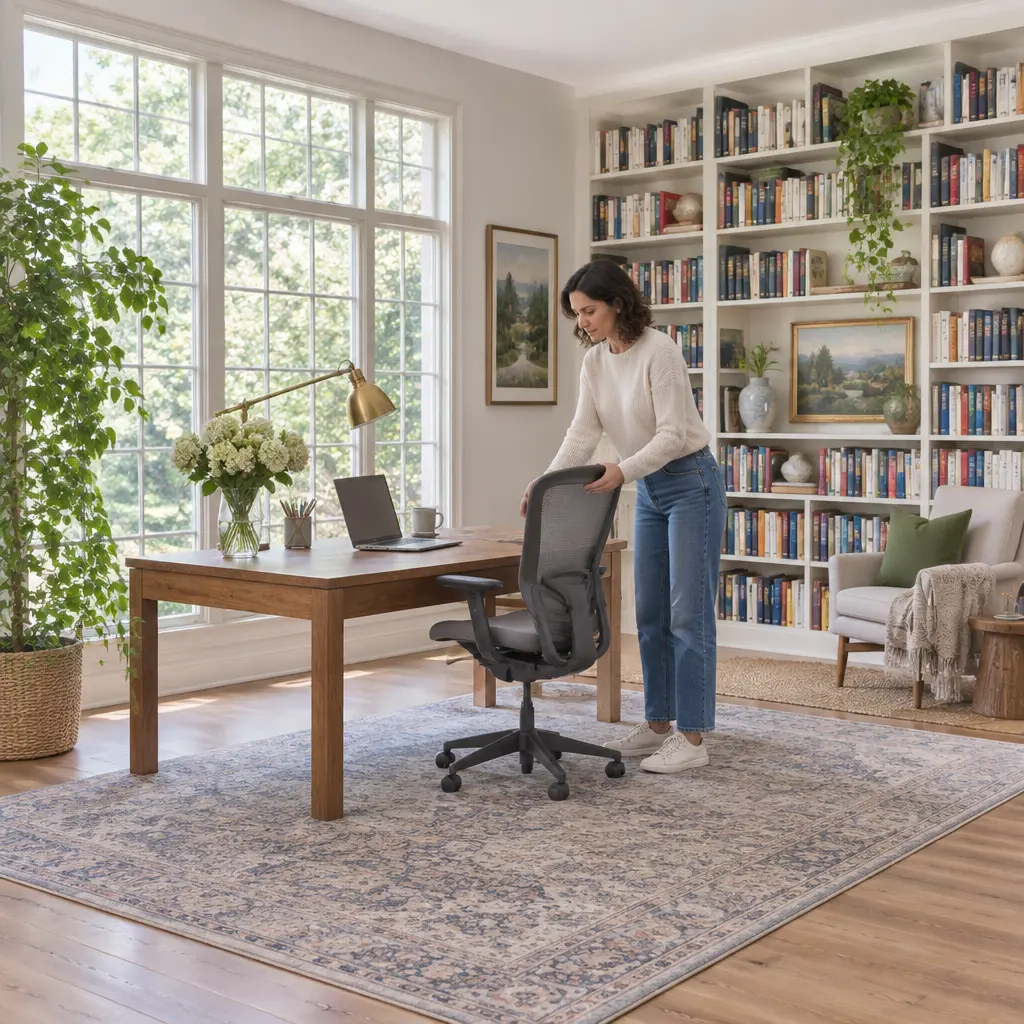
A dedicated work or study area is a recognizable place for tasks requiring attention. A desk, adjustable chair, and adequate task lighting can make materials easier to access and reduce the need to repeatedly rearrange a room. Separating work equipment from a bed or leisure seating may also help some people distinguish work time from rest, especially in a small home where one room serves several purposes.
The Centers for Disease Control and Prevention’s National Institute for Occupational Safety and Health emphasizes that workstation design should account for the worker, the task, and the surrounding environment. That principle cautions against treating a costly chair or standing desk as a universal productivity solution. Better results often come from adjusting screen and work-surface height, placing frequently used items within comfortable reach, and allowing changes in posture. A simple before-and-after assessment—tracking discomfort, interruptions, and task completion—can help determine whether a furniture change is useful.
Living-room seating can support connection or quiet
Seating arrangements influence which forms of interaction a room readily supports. Seats grouped at conversational distances can encourage face-to-face exchange, while a single chair positioned apart from the group can provide a quieter option. Offering both shared and individual seating recognizes that people may want social connection at one moment and privacy at another.
A real-world example is the flexible “activity-based” approach used in some workplaces and community settings: instead of assigning every person one fixed seat, designers provide distinct places for conversation, concentrated work, or informal collaboration. Its success depends on access, noise control, and users’ actual needs. At home, the same principle can be applied modestly by arranging a room with a shared seating area while keeping one comfortable, well-lit seat available for reading or solitude.
Storage and access can reinforce household routines
Storage furniture affects habits by determining how easy it is to find, use, and put away everyday objects. Hooks near an entry, a shoe bench, or labeled shelves can make a departure or tidying routine more convenient. Conversely, storage that is difficult to reach or poorly matched to the objects it holds may make clutter more likely. The behavioral mechanism is reduced friction: when the next step is visible and accessible, people may be more likely to repeat it.
Accessibility is especially important in shared homes. Frequently used items should be placed where intended users can reach them safely, and furniture should not block doorways or essential routes. The U.S. Access Board’s accessibility guidance provides measurable requirements for accessible routes in covered settings; in homes, its broader lesson is to consider usable clearance and reach rather than treating circulation space as leftover space. A weekly reset—returning common items to accessible, consistent locations—can turn storage design into a repeatable household habit.
Thoughtful furniture design balances well-being, flexibility, and real-world constraints
Furniture can support well-being when its design responds to the people who use it, the activities they perform, and the limits of the space. It can also create problems when it is uncomfortable, difficult to access, visually overwhelming, or arranged in a way that interrupts movement. Because homes and workplaces differ, the strongest approach is to observe how a room is actually used rather than assume a single style or layout will improve everyone’s mood.
Flexibility helps rooms serve changing needs
Flexible furniture can be moved, adjusted, folded, or repurposed as needs change. This is useful in compact homes, shared rooms, and households whose routines shift through the day. A movable side table, modular seating, or an adjustable work surface can help convert a room from one activity to another without a major renovation.
Flexibility should not come at the expense of stability or ease of use. Heavy pieces may be hard to move; folding items may be uncomfortable for daily use; and frequent rearrangement can disrupt routines. A practical trial is to make one small change at a time, observe whether it improves comfort or use, and keep it only if the benefit outweighs the added effort.
A simple room audit turns design ideas into action
A room audit is a short review of how furniture supports—or obstructs—daily activities. It can translate general design principles into changes that suit a specific household.
- Identify the main activity for the room and who uses it.
- Notice where discomfort, clutter, interruptions, or blocked paths occur.
- Check whether seating and work surfaces fit the people and tasks involved.
- Move frequently used items within comfortable reach and preserve clear routes.
- Test one change for a week, then ask users whether it improved comfort, mood, or routine.
For example, a household that wants to make weekday meals easier might first clear the dining surface, place frequently used dishes in accessible storage, and ensure that chairs can be pulled out without blocking a walkway. The aim is not to stage a perfect room, but to make the desired activity easier to start and repeat.
Conclusion: furniture shapes mood and habits when design fits people
Furniture affects daily experience through connected attributes: ergonomic fit influences physical comfort; layout shapes movement, privacy, and interaction; sensory qualities contribute to atmosphere; and accessible work and storage arrangements can make routines easier to repeat. Research and public guidance support attention to indoor environments, workstation fit, sleep, and accessibility, but they do not establish that a particular furniture style will produce a guaranteed emotional or behavioral outcome.
The broader implication is that furniture is more than decoration: it is part of the everyday setting in which people work, rest, connect, and care for their homes. Start by observing one room, identify a specific habit or discomfort, and test a small, safe adjustment. For further guidance, consult occupational-health workstation recommendations, accessibility resources, and sleep-health advice from recognized public-health organizations.
Sources: U.S. Environmental Protection Agency, “Indoor Air Quality,” https://www.epa.gov/report-environment/indoor-air-quality; Lewin, K., Principles of Topological Psychology, McGraw-Hill, 1936, https://archive.org/details/principlesoftopo00lewi; U.S. Occupational Safety and Health Administration, “Computer Workstations eTool,” https://www.osha.gov/etools/computer-workstations; Ching, Francis D.K., Architecture: Form, Space, and Order, Wiley, https://www.wiley.com/en-us/Architecture%3A+Form%2C+Space%2C+and+Order%2C+4th+Edition-p-9781118745083; Watson, N.F. et al., “Recommended Amount of Sleep for a Healthy Adult,” Sleep, 2015, https://doi.org/10.5665/sleep.4716; Centers for Disease Control and Prevention, National Institute for Occupational Safety and Health, “Computer Workstations,” https://www.cdc.gov/niosh/topics/ergonomics/; U.S. Access Board, “Guide to the ADA Accessibility Standards,” https://www.access-board.gov/ada/guides/.


