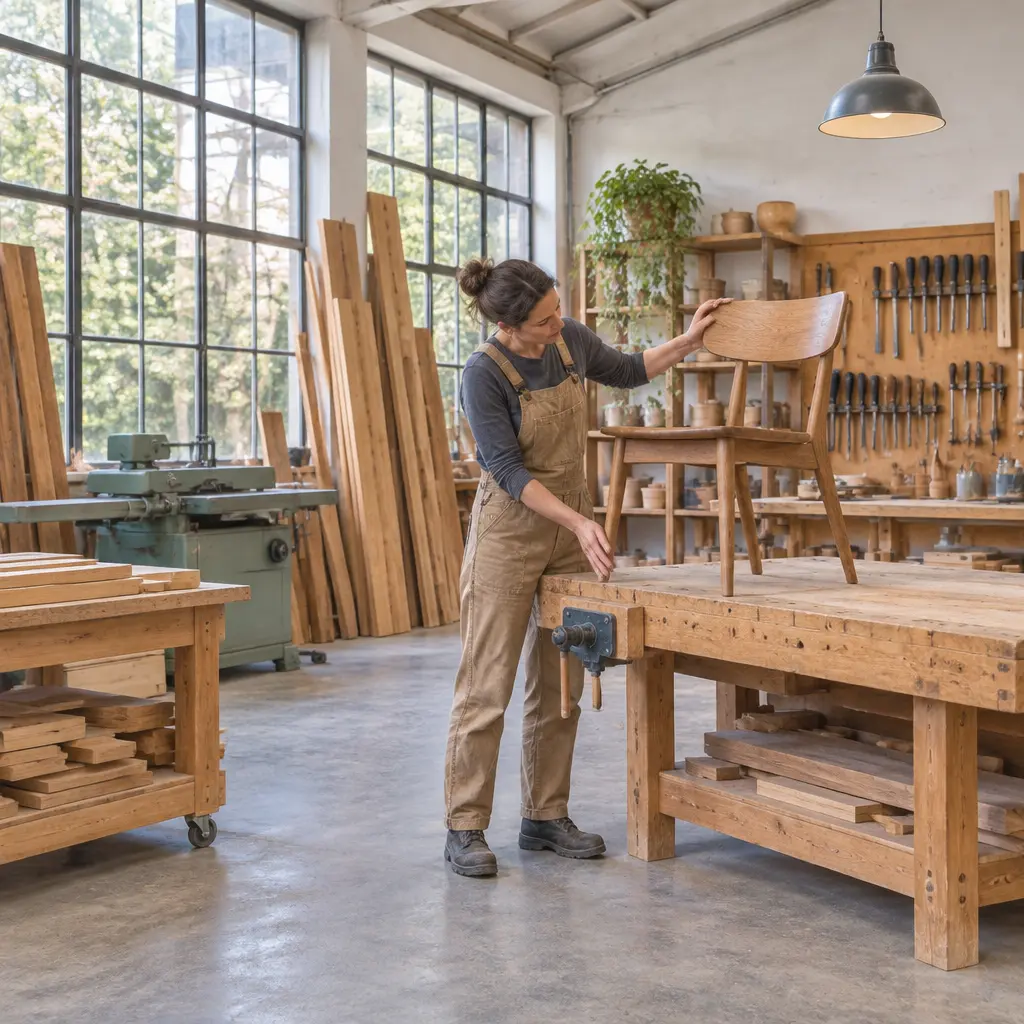
Modern craftsmanship is the deliberate shaping, assembly, and finishing of an object through skilled work, informed material choices, and attention to function. It differs from mass-production shortcuts not simply because it is made by hand, but because decisions about fit, finish, repairability, and quality control remain visible in the result. The distinction matters in a global furniture market valued at hundreds of billions of dollars, where buyers may struggle to tell durable construction from convincing surface imitation. This guide explains how to assess hand-finished detail, materials, construction, and provenance; where contemporary tools fit into craft; and how to make a more informed purchase.
Modern craftsmanship value: definition and distinguishing characteristics
Modern craftsmanship combines accumulated making skills with contemporary materials, tools, design, and production methods. The American Craft Council describes craft through the relationship between maker, material, process, and finished object. In practical terms, craftsmanship is not a guarantee of quality merely because a product is handmade: it is a set of observable choices that serve the object’s use, longevity, and appearance.
Mass production, by contrast, uses standardized processes and repeated operations to produce goods at scale. That approach can deliver consistent, affordable, well-engineered products. A shortcut occurs when a maker or manufacturer reduces cost or time by compromising a meaningful feature—for example, using a weak joint, hiding a poor edge beneath trim, or applying a finish that conceals defects rather than protecting the material. The relevant comparison is therefore not “handmade versus machine-made,” but thoughtful execution versus compromised execution.
Several related forms fall under modern craftsmanship: studio craft, small-batch production, artisanal manufacturing, heritage trades, and digitally assisted making. Their methods differ, but each can be judged by the same questions: Is the product fit for its intended use? Are its materials and construction accurately described? Does the finish support durability? Can the maker explain how it was made and how it can be maintained?
Hand-finished detail: evidence of purposeful work
Hand-finished detail refers to the final operations in which a person refines surfaces, edges, joints, or decorative features. Examples include sanding a wooden edge to a comfortable radius, burnishing leather, tuning a drawer for a smooth fit, or applying and leveling a finish. The defining feature is not the presence of a human hand alone, but skilled judgment at a stage where small adjustments affect the object’s feel, function, and appearance.
Look for consistency appropriate to the material rather than mechanical perfection. A carefully made wooden object may show subtle grain variation, while a well-finished metal part may have uniform edges and no burrs. These are not universal tests: some handwork is decorative, and some factory finishing is excellent. The strongest evidence comes from details that are both visible and functional, such as cleanly aligned seams, smooth contact surfaces, and joints that do not loosen under ordinary use.
Mass-production shortcuts: what to inspect
A production shortcut is a design or process choice that reduces effort or cost at the expense of expected performance, serviceability, or honest representation. It may be difficult to identify from a product photograph, so inspect the object itself when possible. Check undersides and rear surfaces, where construction is often easier to see; open and close moving parts; examine edges and seams; and ask what materials are used in load-bearing areas.
- Furniture: inspect whether joints are mechanically secure, whether panels are solid wood, veneer, or composite, and whether drawers run squarely.
- Clothing and bags: check seam allowances, stress points, hardware attachment, lining, and whether the fabric weight suits the intended use.
- Metal goods: look for cleanly finished edges, stable connections, and an appropriate protective coating.
- Ceramics and glass: assess whether the base and rim are finished for safe handling and whether the maker explains expected variation or care requirements.
A machine-made product is not automatically a shortcut, and a handmade product is not automatically durable. A CNC-cut part can be accurate and robust; a hand-assembled item can still contain poor materials or weak connections. Evaluate the outcome and the evidence, not the marketing category.
Materials and construction reveal craftsmanship value
Materials and construction are the physical basis of a product’s service life. The U.S. Federal Trade Commission’s Guides for the Furniture Industry set rules for claims such as “solid wood,” “veneer,” and “all wood,” underscoring why precise descriptions matter. Buyers should distinguish a material’s name from its grade, thickness, source, and role in the product. A carefully specified composite panel may be suitable for a particular use, while an undisclosed substitution can mislead.
Material selection and honest disclosure
Material selection is the process of matching a substance to the demands of use, environment, repair, and appearance. A craftsperson should be able to explain why a material was chosen and what its limitations are. For example, solid wood can be repaired and refinished, but it expands and contracts with humidity; leather develops wear patterns, but its performance varies by tanning and finish; and recycled materials may reduce demand for virgin inputs, but their composition and durability still need verification.
The U.S. Environmental Protection Agency estimates that 12.1 million tons of furniture and furnishings entered the U.S. municipal solid-waste stream in 2018, with 80.1% landfilled. These figures are a reminder that replacement and disposal have material consequences. They do not prove that every expensive or handmade item is sustainable; they support asking about expected service life, repair, and end-of-life options.
Joinery, assembly, and repairability
Joinery is the method used to connect parts, and it often reveals whether a product was designed for strength, speed, or both. Traditional wood joints include dovetails, mortise-and-tenon joints, and dowels; contemporary products may use screws, brackets, adhesives, or engineered connectors. No single joint is best in every application. What matters is whether the connection suits the load, material, and expected maintenance.
Repairability adds value when components can be accessed, replaced, or refinished without destroying the whole object. Ask whether hardware is standard, whether replacement parts are available, and whether the maker offers repair guidance. The European Commission’s Ecodesign for Sustainable Products Regulation, which entered into force in July 2024, establishes a framework for improving product sustainability and information; product-specific requirements are developed through subsequent measures. It signals a broader policy shift toward durability, repair, and resource efficiency rather than treating disposal as inevitable.
Finishing quality connects appearance with performance
A finish is a surface treatment that changes appearance, feel, or resistance to wear, moisture, corrosion, and staining. Hand-finishing can involve several stages—preparation, application, drying, leveling, and final polishing—but the right process depends on the material and the object’s use. A glossy surface is not necessarily better than a matte one, and a perfectly uniform coating is not the only sign of quality.
Surface preparation and tactile quality
Surface preparation removes defects and creates a suitable base for a coating or final polish. On wood, that can mean sanding with progressively finer abrasives and removing dust; on metal, it may involve deburring, cleaning, or applying a primer. Poor preparation can cause uneven sheen, rough edges, peeling, or visible scratches. Examine surfaces in good light and, where appropriate, feel edges and contact points for splinters, burrs, or abrupt transitions.
Natural materials may show variation in color, grain, or texture. Such variation can be evidence of the material itself, not a flaw. The useful distinction is whether the variation is expected, disclosed, and compatible with the product’s quality standard. A seller should explain what variation is normal and what would qualify as damage or a manufacturing defect.
Finish durability and care instructions
Finish durability describes how well a surface treatment tolerates the conditions it is likely to encounter. A dining table needs different resistance from a decorative wall object; outdoor furniture must withstand ultraviolet exposure and moisture. Ask what cleaning products are safe, whether the finish can be renewed, and what environmental conditions to avoid. Clear care instructions are a practical sign that the maker has considered ownership beyond the point of sale.
A comparison chart can help buyers assess products consistently: list the material, construction method, finish, repair options, warranty, and care requirements for each item. This makes it easier to distinguish a useful investment from a premium price supported mainly by branding.
Provenance and skilled labor substantiate craftsmanship claims
Provenance is the documented origin and history of an object, including who made it, where it was produced, and what processes or materials were used. It supports craftsmanship claims when information is specific and verifiable. “Made by skilled artisans” is less informative than naming the workshop, describing the maker’s role, and identifying which operations were completed by hand and which by machine.
Maker transparency and production scale
A transparent maker explains production scale, sourcing, quality checks, and the division of labor. Small-batch production can allow closer inspection and customization, but it is not proof of superior workmanship. Likewise, industrial production can apply stringent testing and repeatable tolerances. Buyers should look for evidence: process photographs, detailed specifications, named materials, repair policies, and direct answers to technical questions.
The International Labour Organization’s work on skills and vocational training highlights the importance of developing and maintaining occupational skills as industries change. In craft sectors, those skills include not only manual technique but also material knowledge, measurement, design interpretation, and quality control. Supporting skilled work can help sustain knowledge that is difficult to replace once workshops and training pathways disappear.
Price, warranties, and evidence of value
Price reflects more than labor: it may include material quality, design, tooling, overhead, distribution, and after-sales support. A high price alone does not establish craftsmanship, while a lower price does not prove poor quality. Compare the item’s construction and expected service life with the cost of maintenance or replacement. A written warranty is useful evidence of the seller’s commitment, but read its exclusions and duration rather than treating it as a substitute for inspection.
One practical measure is cost per year of use: divide the purchase price by the number of years the product is expected to remain useful. This estimate is not a complete environmental or financial assessment, but it encourages comparison beyond the initial sticker price. Use realistic assumptions and include repair costs where known.
Digital tools can support, rather than replace, modern craftsmanship
Contemporary craft often combines hand skills with digital design, laser cutting, 3D printing, and computer numerical control machining. These tools can improve accuracy, reduce material waste, and make complex forms feasible. Their use does not make a product less crafted; the important questions are whether the process is appropriate, whether finishing and assembly are well executed, and whether production claims are truthful.
Hybrid production and quality control
Hybrid production pairs automated repeatability with human judgment. A machine may cut identical components, while a craftsperson selects grain orientation, fits joints, sands edges, or adjusts a finish. This division can preserve detail while meeting contemporary demand. Manufacturers should still disclose which steps are automated and which are hand-finished, especially when those distinctions form part of the product’s value proposition.
A useful example is a made-to-order chair: digital design can establish dimensions and produce consistent parts, while a skilled worker checks the frame, aligns connections, and finishes contact surfaces. The case illustrates why “machine-made” and “handmade” are not mutually exclusive categories. Quality depends on the entire chain, from design and material choice to final inspection.
How to evaluate craftsmanship before buying
A structured inspection helps separate demonstrable quality from attractive storytelling. When shopping in person, handle the object and inspect less visible areas. When buying online, request close-up photographs, material specifications, production details, and written care or warranty terms.
- Identify the intended use and the stresses the object will face.
- Confirm the material, construction method, origin, and any claimed hand-finishing.
- Inspect joints, seams, edges, moving parts, and hidden surfaces.
- Ask how the product can be cleaned, repaired, refinished, or supplied with replacement parts.
- Compare warranty terms and expected service life with the purchase price.
- Look for independent reviews, maker documentation, or relevant safety and material certifications.
For a visual aid, a buyer’s comparison chart can score each candidate on construction, finish, material disclosure, repairability, and provenance. The chart should record evidence rather than impressions—for example, “replacement drawer runners listed” is more useful than “seems well made.”
Conclusion: craftsmanship value depends on evidence and care
Modern craftsmanship is best understood as skilled, informed production—not a label reserved for objects made entirely by hand. Hand-finished detail can reveal careful judgment; materials and joinery determine much of an object’s strength and repairability; finishing affects both feel and protection; and provenance helps buyers verify how and where work was done. Mass production can produce excellent goods, but shortcuts become a concern when they conceal weak construction, poor disclosure, or limited service life.
The broader stakes include preserving skilled knowledge, reducing avoidable replacement, and rewarding makers who explain their processes honestly. Before purchasing, inspect the product, ask specific questions, and weigh repairability and expected use alongside appearance and price. Further reading from the American Craft Council, the U.S. Environmental Protection Agency, and the European Commission can help consumers connect craft choices with materials, waste, and product policy.
Sources: American Craft Council, About Craft and the American Craft Council, https://craftcouncil.org/about/; U.S. Federal Trade Commission, Guides for the Furniture Industry, https://www.ftc.gov/business-guidance/resources/guides-furniture-industry; U.S. Environmental Protection Agency, Durable Goods: Product-Specific Data, https://www.epa.gov/facts-and-figures-about-materials-waste-and-recycling/durable-goods-product-specific-data; European Commission, Ecodesign for Sustainable Products Regulation, https://environment.ec.europa.eu/topics/circular-economy/ecodesign-sustainable-products-regulation_en; International Labour Organization, Skills and Lifelong Learning, https://www.ilo.org/topics-and-sectors/skills-and-lifelong-learning.